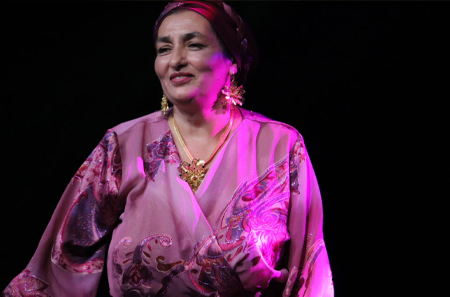
An interview with Perła Krystyna Markowska, singer, leader of the band Perła i Bracia, and president of the Centre for Roma Advice and Information in Poland.
Introduction
Perła Krystyna Markowska – a distinguished artist, vocalist, Roma activist, and head of the Centre for Roma Advice and Information in Poland. Born in Otwock, née Wiśniewska, she comes from the Polska Roma group. For many years she has combined artistic work with social engagement, becoming one of the most recognizable Roma women leaders in Poland.
Perła is also the founder and leader of the band Perła i Bracia, which performs vocal-instrumental Roma music, drawing inspiration from jazz and from the traditions of the Sinti and Eastern European Roma. In their new arrangements of old songs, the group preserves authenticity and emotional honesty, always performing live. On stage, Perła is accompanied by her husband – guitarist Zdzisław Markowski. Together they create music that connects generations and reminds audiences of the enduring strength of Roma culture.
The Roma Anthem – “Djelem, Djelem”
Today we meet to talk about “Djelem, Djelem”, the Roma anthem. The lyrics were written by Žarko Jovanović – a Serbian Roma poet and activist who fought in the resistance movement during World War II and later settled in Paris. The text is based on a traditional Roma melody from the eastern Balkans. The song carries the memory of the Roma genocide, but also a message of unity, strength, and pride.
During the First World Roma Congress, held in London in 1971, the piece was officially adopted as the Roma anthem, together with the Roma flag. It was a groundbreaking moment – the first time Roma people appeared on the international stage, presenting their own national symbols.
The Roma Flag
The Roma flag consists of two horizontal stripes – blue at the top, symbolizing the sky, freedom, and spirituality, and green at the bottom, representing the earth, nature, and rootedness. In the center is a red wheel – the wheel of a wagon, symbolizing the Roma journey and identity. The wheel also refers to the Indian chakra, reminding us of the Roma’s ancestral origins in India.
E-Drom: Krystyna, why was the song “Djelem, Djelem” chosen as the Roma anthem?
Perła Krystyna Markowska: Honestly, there aren’t many historical sources explaining this in detail. The decision was made at the 1971 Roma Congress in London. It was the participants who proposed this song. Perhaps there were no other suggestions, or perhaps they simply felt that Djelem, Djelem best expressed the spirit, unity, and history of the Roma people.
E-Drom: What message does the song carry?
Perła: It’s a song about travelling and about encounters – about how Roma people, wherever they are, carry the same memory and longing for freedom and togetherness. In our songs, meanings are often hidden. When we sing “there is no bread, there is no water,” it’s not just about hunger – it’s about the lack of life and hope. Djelem, Djelem also hides such deeper meanings: it speaks about life, about the fate of the Roma, about our history and the experience of persecution.
E-Drom: The song speaks of travelling – Roma people still move around today, though in different ways. Is that symbolism still relevant?
Perła: Very much so. Travelling is a part of us – only the means have changed. Today it’s not wagons and horses, but cars, trains, and planes. Many families move in search of work, a better life, or simply to be with their relatives. And not because Roma are “romantic” and love to wander – it has never been a matter of romanticism, but of history and necessity.
In the past, travelling was work: making pots, repairing tools, trading horses, fortune-telling. It wasn’t adventure – it was survival. When a community no longer needed certain services, people had to move on. During the war, they travelled to hide and to save their lives.
Today, the reasons are often the same as for many Poles: better opportunities, employment abroad, or more openness in Western societies. In countries like the UK or Ireland, Roma people find work more easily, as diversity there is a normal part of life. So yes – the journey continues, but it has changed form. It’s not romanticism – it’s life.
E-Drom: For young Roma people – what message does Djelem, Djelem carry?
Perła: Young people understand very well what an anthem means. They know that every nation has one – and so do we. When they hear Djelem, Djelem, they stand up immediately, because it’s more than just a song. It’s a symbol of community, memory, and dignity.
E-Drom: During our Summer Workshop Camp – a camp for young Roma from Poland, the Czech Republic, Slovakia, and Hungary, focused on developing social skills and strengthening Roma identity – the artist Angelo Czureja, who led the singing workshops, announced that he would perform Djelem, Djelem, the Roma anthem. Everyone stood up at once. The Roma sang, while the non-Roma stood silently in respect. The atmosphere was deeply solemn. It was a moment that showed just how powerful and unifying this song is. What do you think lies behind that power?
Perła: I think it’s the shared emotion – that collective experience. Even if not everyone knows the words, the anthem touches something deep inside. It carries not only history but also emotion, memory, and a sense of unity.
E-Drom: Do you perform Djelem, Djelem with your band Perła i Bracia?
Perła: No, we don’t. Out of respect for the anthem, we don’t include it in our concerts. If I were to sing it, I would perform it as an anthem – solemnly and with reverence. But not every concert or festival is the right context. I wouldn’t want people to dance to the anthem – that would feel disrespectful.
E-Drom: How do you feel about various interpretations of this song – from traditional to modern, like those by Barcelona Gipsy Klezmer Orchestra or Viki Gabor?
Perła: I’ve heard many versions. Sometimes it’s no longer the anthem, but rather a traditional song with different words and rhythm – and that’s fine, as long as people know the difference. When someone announces Djelem, Djelem as the anthem, we stand up – because then it’s a symbol. But when it’s performed artistically, it becomes a folk song again – and that’s beautiful in its own way.
E-Drom: The Roma flag was adopted at the same Congress as the anthem. What does it mean to you?
Perła: I think it’s very meaningful. The blue is the sky and freedom, the green is the earth and rootedness, and the red wheel represents our journey and our origins in India. It’s everything that’s in our hearts. Older generations may not display it openly, but young people identify with it strongly. I often see them wearing T-shirts with the flag or posting it on social media – and that’s wonderful. It shows pride in being Roma.
E-Drom: So the anthem and the flag still unite Roma people?
Perła: Yes – and more than ever. Older Roma didn’t need to show who they were; they simply knew. Today’s youth want to express it – and that’s great. In a world where pop culture makes everything look the same, these symbols help us preserve our identity.
E-Drom: Thank you, Krystyna, for this conversation and for reminding us that a song can be more than just music – it can be memory, pride, and community.
Djelem, djelem (Short Version)
Djelem, djelem, lungone dromensa,
Maladilem baxtale Romensa.
A Romale, katar tumen aven?
E, cheasa baxtale Romalen!
Translation
I travelled long, long roads,
I met happy Roma.
Oh Roma, where do you come from?
With joyful, happy Roma!
Djelem, djelem (Long Version)
Djelem, djelem, lungone dromensa,
Maladilem baxtale Romensa.
Djelem, djelem, lungone dromensa,
Maladilem baxtale Romensa.
Ay, Romale, Ay, Chavale,
Ay, Romale, Ay, Chavale.
Ay Romale, katar tumen aven,
Le tserensa baxtale dromensa.
Vi man sas e bari familiya,
Tai mudardya la e kali legiya.
Aven mansa sa lumake Roma,
Kai putaile le Romane droma.
Ake vryama – ushti Roma akana,
Ame xutasa mishto kai kerasa.
Ay, Romale, Ay, Chavale,
Ay, Romale, Ay, Chavale.
Translation
I travelled along long roads,
I met happy Roma.
I travelled along long roads,
I met happy Roma.
Oh Roma, oh children,
Oh Roma, oh children,
Where do you come from,
With your happy homes and bright roads?
I once had a large family,
But the black legion killed them.
Come with me, Roma of the whole world,
For the Roma roads are opening again.
Now is the time – rise, Roma,
Let us unite and build together.
Oh Roma, oh children,
Oh Roma, oh children.
The development of the traditional Roma culture portal E-Drom was co-financed by funds from the Minister of Culture and National Heritage, originating from the Culture Promotion Fund.