
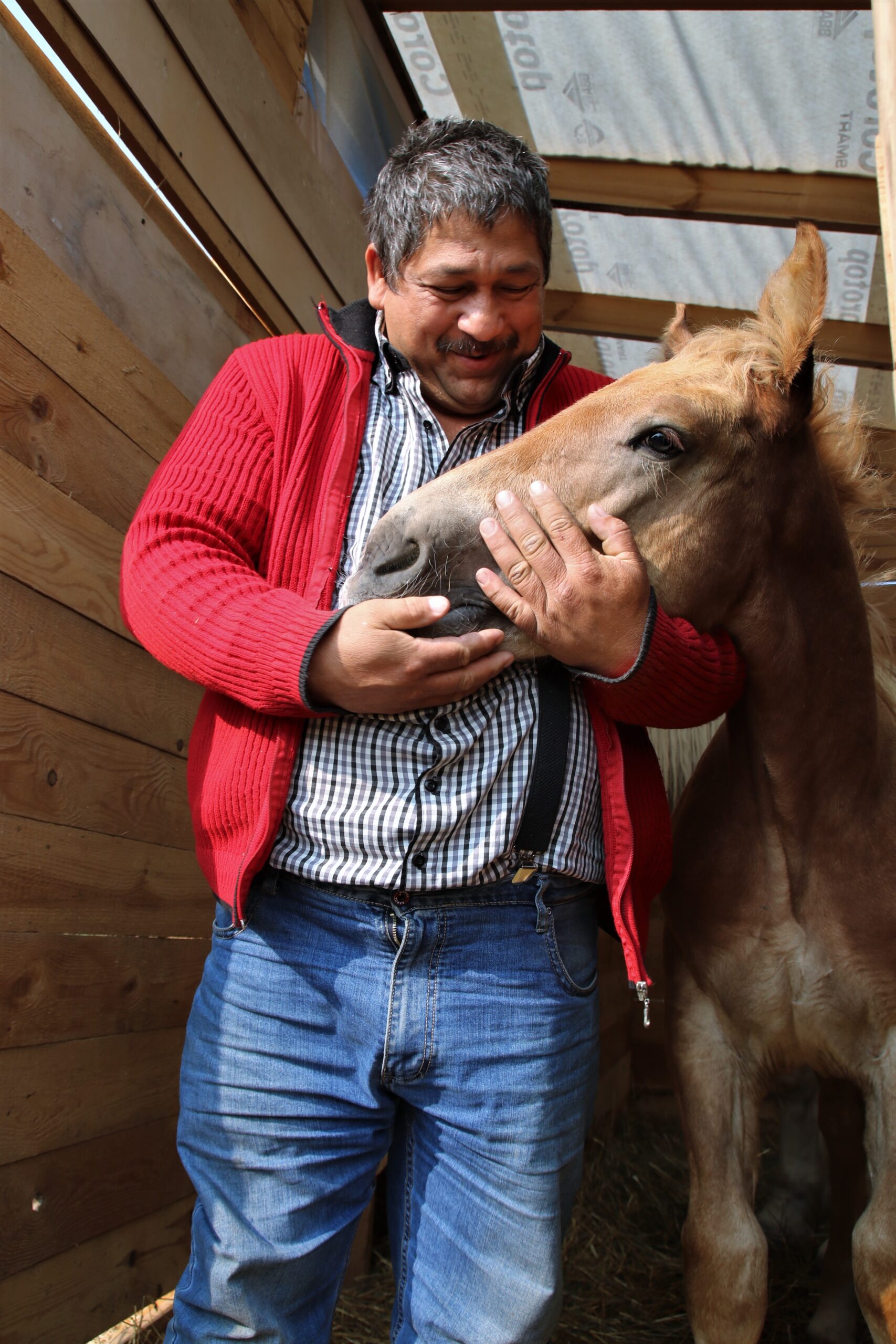
We’re meeting with Tadeusz Bosman Krzyżanowski in Warsaw in a restaurant with Middle Eastern food, meat rather than vegetarian. I’ve known Bosman and his family for many years, so we will address each other by name.
– Where does your lineage come from, Bosman?
– On my father’s side we are Łomźiniaki Polish Roma. Great-grandmother came from near Łomża, we no longer know exactly from where, but one of the towns there, maybe a large village, was their permanent wintering place. My father’s sister went there years later and the locals remembered great-grandmother. Old history, pre-war. Then the Germans killed most of my family. Great-grandmother and her brothers, luckily for them, were out of the village on some kind of trade or food search. When they came back, everyone who stayed behind was already dead.
After the war, like most of the Łomża people, they wandered in tabors through Pomerania, Kuyavia, northern Mazovia, and when forced settlement came in the mid 1960s, my great-grandfather Tońko Wajs (brother of Dyźek Wajs – Papusza’s husband) and many other related families settled in Bydgoszcz – in Łęgnowo. There they have always stationed their caravan at the perfect spring and there they have stayed and built a home. My grandmother on my mother’s side was from the Pawłowski family from Żywiec, and her husband, my grandfather, came from the Roma Sanocki family – the Galicians.
In Łęgnów they all lived together, the great-grandparents and their children’s families, side by side, in barracks and small houses that they built themselves. They ran the farm. There were horses, cows, pigs – for themselves and for sale – they had to live off something. And that’s where all the children went to school. I was already the third generation in Łęgnów’s school.
– How do you recall that time, what was school like for you and your parents?
– The teachers had a knack for “educational work”. They had known and practised on our fathers, uncles, aunts and cousins before, so it wasn’t easy for us either. The way I look at it today, with the experience of a modern school and our work as Roma assistants, it was simply racism, discrimination, almost bullying. No one gave us any chances. “There’s nothing to be made of these Gypsies”, “like father, like son”, we were given “E’s” for just anything, we were beaten on the hands with a ruler. Nobody cared whether I learned anything or not. Whether or not I would pass the next class. So I didn’t pass, I got bullied and quickly lost the will to learn. But to be fair, my Polish and geography teachers were fair and good and I remember them well.
Also, the work at home, on the farm, did not help much with my studies. I saw less and less of that school. There were more important things to do – the animals had to be groomed, the haymaking had to be done – and I was no longer at school. Backlogs, failed classes, notebooks not filled in. It started to get really unpleasant – my brother was in the same situation. Attempts were made to humiliate us, punish us, and complain to our parents. Of course, not only was there no improvement, but we were even more fierce about not giving in to that school and I spent three consecutive years in the fourth grade. Not only not to give in to the school, but also to my classmates – the older ones, for whom a Gypsy kid is always a welcome target for jokes. It was not easy for them to joke about us, our fists had to be hard. In general, relations with non-Roma children were either frail or bad – we were separate and excluded from sincere friendships.
In the end, my brother and I were given exams to test our level of knowledge and intellectual ability. And out of spite and for a joke, we filled them out deliberately as badly as possible – apart from educationally, we were really very behind. It couldn’t have ended well for us. My father got really angry and gave my brother and I an ultimatum – will you study? No. Then you’ll go to a detention centre. So we’ll go!
I was fourteen and I was already being treated almost like an adult, I was responsible for my words. And you know how it is with the Roma – when you said it, you had it. And one fine day my father drove us off to an institution in Mogilno, a hundred kilometres from Bydgoszcz.
The first months were like being in a prison. A regime, an almost prison-like discipline. I spent two years there, my brother a year. On the one hand a disaster, a nightmare. But there not only I matured, grew up, but also got out of trouble, got back on track. It was the best thing that could have happened to me then. Not that the discipline helped me, but I met decent people who really took care of me – tutors and teachers who not only didn’t let me go, me – a rascal and an ignorant, thinking I wouldn’t make anything of me anymore, but demanded, pushed and helped! I really came across good people.
– And peers, colleagues?
– Again, there weren’t any close relationships, but also because many of the pupils were kids with different disabilities. It was a different kind of experience, very important for me today, when I work in a school myself, with children and I see what deficiencies they have, what they need, how to recognise what they are good at, how to get through to them, what motivates them – this facility is a school of life.
– How did the story end?
– I took the plunge. I finished fourth grade, did fifth and sixth the following year and at the beginning of seventh grade I announced to the teachers that I was going to say goodbye to the school, that I wouldn’t be coming back – they thought I was joking. On my own, without letting anyone know, I arranged with the superintendent to transfer during the school year to a school in Bydgoszcz. I wanted to go to a boarding school, but there was no possibility of finishing seventh grade there. And so I ended up at a school on Fordońska Street – again happy and again with wonderful teachers and a wise headmaster. At the end of eighth grade, as we said goodbye, we all cried. But before I finished it, I was already working. Uncle Góral had a thriving service business – tinning food equipment. For a year I lived and worked with my uncle without leaving school. An old Roma profession – we earned well – bakeries, meat factories, pastry shops – we bleached boilers, food utensils, hooks in shops and meat factories etc. with tin. At the same time, I was going to school, all my absences were excused, I was catching up, I really wanted to finish this school. It was a special school with well-educated educators and teachers. And they were already well prepared at that time, in the early 1980s, to work with kids with different problems, with different histories, sometimes very difficult. And with the Roma student – they knew that you had to work a little differently, even though I was the first and only one there. Great school, great teachers. I still keep in touch with some of them to this day.
– You finished primary school and then what?
– And I enrolled in a vocational school, first as a carpenter, but then I switched to horticulture. I haven’t studied much gardening, because my uncle from Leszno, my mother’s brother, came and said: drop out of school, let’s go into trade. So we did – antiques, recovering gold from gold-plated watches – we did very well. I was 16, 17 years old and already leading an adult life. I met Marlena and got married. To a Polish woman. The family was a bit disappointed, but after 30 years of living an honest life together, we have their respect. We were already entering the 1990s as a family and trading together. We lived very well, but it was a life on the road – constant trips, camping, but also more and more resentment, anger from people, accusations of theft, you know yourself how our neighbours can get on us. It was a bit too much for us.
– Hence the idea for the Association, the social activities?
– It coincided. My brother was living in Kłodzko and we found out that there was a Roma association there, and they help people with renovations, school kits and things like that. Vaguely someone said something, didn’t quite know. But we got in touch with the Lower Silesian Governor’s Plenipotentiary for National Minorities, Małgorzata Milewska, and she sent us a template of the documents needed to register the association and information about the government programme for the Roma community. That was 2005. We went around the Bydgoszcz elders to explain everything, get their approval and we established the association in Bydgoszcz. Bogdan Zieliński, one of the Roma elders, became the first chairman, I was still too young then.
– And why did you need the Association?
– I believed it was possible to help the community, like elsewhere where a government programme was already in operation. I had money from the trade and I thought it wouldn’t be a big problem for me. At the time I was still thinking very naively. We started with a small project to buy textbooks and school aids for Roma students – books, notebooks, backpacks, pencil cases, crayons. We then had to turn up at each family and collect a confirmation that these aids had reached them. The following year, the children themselves called us, came and asked if there would be notebooks, pencils. Well, you can’t go back and tell them no – there won’t be. They’ve already got you!
– How many of these children were there?
– A whole bunch in Bydgoszcz, but in schools 20, 30 pupils at most – less than half – the rest at home, with their parents on trade trips, but not at school. At the time, the city wasn’t very interested in this not insignificant group of children either. Even though they were included in the compulsory schooling documents somewhere, the school never saw them and didn’t particularly miss them.
– What can be done, what should be done in such a situation?
– I had no idea, how was I supposed to know that? But then I ended up in Warsaw for a training course on preparing and implementing projects for the Roma community, and there, among other things, I heard for the first time about Roma education assistants. It intrigued me so much that I felt, and in a moment knew for sure, that this is what we need in Bydgoszcz. Two years later, after training, getting into the topic, the issues, I was already an assistant. And in another couple of years there were three of us. But before that, it was crucial to activate an increased educational subsidy for schools organising an extra educational task for Roma pupils. A mechanism that, if it works well (it’s not so obvious in all cities), makes it possible to really provide solid support for these essential activities for Roma children, to provide them with a variety of help. It also makes it possible to employ Roma assistants on permanent contracts. In Bydgoszcz we have managed, together with school principals, teachers and the Education Department of the City Hall, to set up this mechanism almost as a good model.
– And on a day-to-day basis, what does this work involve?
– We act kind of as advocates for special tasks – mediator, liaison officer, rescuer, peacemaker, firefighter. We have to see, to keep an eye on anything that might ignite at the interface between the Roma home, the parents, the children, the other pupils (also non-Roma), the teachers, the educators, and finally the municipal administration. We are always on the side of the Roma pupils, that is the basis, it is for them that we are at school. And that sometimes means that we have to explain to them and their parents that the school is right. That what is sometimes considered to be an injustice or a dislike for this pupil is simply a necessary requirement, a necessity that is the same for all pupils. On the other hand, teachers, educators also learn from us the reasons for some troubles, thanks to us they can understand some situations or behaviours related to traditions and family obligations.
– It’s been almost 20 years of you being in Bydgoszcz schools, do you see any change?
– First of all, the attendance rate. We used to have less than 40% of children in schools, now it is 95%. School has become something ordinary for pupils and their parents, no longer threatening and sometimes even helpful. Those parents who still go out to trade leave their children in the care of the school and assistants without much concern. In exceptional cases due to tradition and the need to organise the care of their growing daughters, it has also happened that the female assistants have been the ones to provide this direct care, guaranteeing their safety. This all works for trust and attendance success.
At this point in our conversation, a young man rose from a neighbouring table to apologise for interrupting, but he had been listening to our conversation for a while and wanted to thank Bosman for his work and congratulate him on this change in the school he was describing. He himself comes from Lipno and in the first grade of primary school he sat on a bench with a student nearly 10 years older – Roma. Despite the age difference, they were good friends and still have a warm relationship today.
– As you can see, your school history was not entirely unusual.
– Unfortunately, I have the impression that it was the standard for my generation and those before.
– Let’s go back to modern day school. What is the biggest problem today?
– We have more and more work with students with special education certificates, individual teaching, these less obvious cases, which are more numerous than even ten or five years ago, and require observing procedures, deadlines, examinations. Although we have almost all of Bydgoszcz’s children in education, their attendance is still below average. Business trading trips, weddings, funerals, sick family – the obligation to be present, to be with the family in such situations, means missing sometimes several days. Although the average academic performance does not differ from the average of other students in the schools, these disappearances, absences certainly do not help learning. We do, however, organise a large amount of extra teaching, which goes a long way to bridging these gaps.
– And how does the recruitment process for secondary schools look like? Is there an increase in the number of Roma students in such schools and then in university?
– The number is increasing, of course. It must be the case. Most young people and parents realise that primary school is no longer enough. That the trade and those professions that allowed us full independence from the non-Roma system are coming to an end. Roma are increasingly looking for jobs in professions that require schools. So we have students in vocational schools, technical schools, and also in high schools. There are already Roma at university too. But you can see that it is easier for children from mixed families, where this experience of learning has been in the families before. There are students who are very talented, also athletically. We had some such young athletes already on the national scene, but early marriages, family responsibilities, do not help them develop their careers.
– How do you see your future in this profession? Do you have successors?
– Assistants are still needed and will still be needed. In Bydgoszcz, but especially in those places where sometimes in one school there is a large group, several dozen Roma children, and one or two assistants at the most. There are serious problems there! Roma children everywhere will have a difficult time in school – we have to stand behind them, they need to know they can count on us. I don’t see any successors yet. I know that a similar concern is expressed by other assistants. It’s hard work, not necessarily well paid, requiring constant exposure to trouble whether at school or in Roma homes. Only to be envied (laughs).
– Tell us about the horses, then.
– It’s been a dream for years. Horses were always a Roma thing. We had horses, we would buy them, sell them, talk about horses. I grew up with horses and I was able to realise my dream of having them. Special programmes helped me to do it – I have Sokolski horses, a breed of Polish cold-blooded horses, whose breeding is supported by the state. Today I have three fillies and three foals, and before that we also had stallions. Ultimately, for this breeding to be financially stable, there should be at least 10 fillies. But for now we don’t have the conditions, a big enough parcel of land, pasture – a difficult thing, especially in the last two or three years, when everything has become terribly expensive, from veterinary care to hay. So we’ll have to cut down on the breeding still and maybe start offering other kinds of services too – recreation, hippotherapy or rides on a stock wagon. We will see!
Interviewed by Andrzej Grzymała-Kazłowski