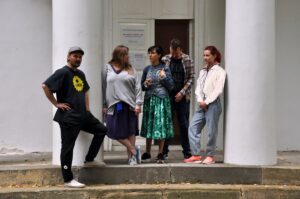
- Ceroplastic exercises at the “Chapel/Kaplica” Gallery at the Centre of Polish Sculpture (CRP) Orońsko
On the photos: Małgorzata Mirga-Tas, Marcin Tas, Eve Tsinska, Leszek Wejcman, Monika Weychert
Photos taken by: Małgorzata Brus
16.07.2020
It was Saturday, July 1942, when German gendarmes and Polish policemen stopped a group of 29 Roma nearby Borzęcin Dolny. 3 men, 5 women and over 20 children were murdered by the Germans and Poles on the very same day in the nearby forest. Their bodies were thrown into a pit dug at the site of the execution and buried.Almost 70 years later, in July 2011, in Cygańskie Górki (Gypsy Hills) – as the locals used to call this place after the execution – a Romani sculptor, Małgorzata Mirga-Tas, designed and created a wooden monument dedicated to the Roma genocide. (…)
Four years later, in the spring of 2016, a group of criminals, still undetected, destroyed the monument. The Roma were killed once more by the Poles. (…)
In July 2016, the artist recreated the monument in its original form and in its original place. She took the remains of the first sculpture and the remains of the Roma chopped up with an ax.
Those remains became the subject and the base of her new sculptural series, shown in the “Chapel/Kaplica” Gallery at the CRP in Orońsko. (…) The exhibition consists of wax casts of the destroyed sculptures and their parts. (…)The artist did not fix the mutilated sculptures. She did quite the opposite – she cared for their wounds emphasizing the fragmentation, fragility and precarity of the remains.
excerpts from the curatorial text by Wojciech Szymański
06/06/2020 – 11/10/2020
“Chapel/Kaplica” Gallery at the CRP Orońsko
Artist: Małgorzata Mirga-Tas
Curator: Wojciech Szymański
Coordinator: Jarosław Pajek